|
The Falcon launch vehicle family is designed to provide breakthrough advances in reliability, cost, flight environment and time to launch. The primary design driver is and will remain reliability, as described in more detail below. We recognize that nothing is more important than getting our customer’s spacecraft safely to its intended destination.
Launch Manifest
Below is the upcoming launch manifest. SpaceX has launch complexes at Cape Canaveral, Vandenberg and the Marshall Islands (Kwajalein Atoll), allowing direct launch to any inclination. Through our Kwajalein launch site on Omelek Island, SpaceX is the only US heavy lift provider with an equatorial launch location.
| Customer |
Launch Date |
Vehicle |
Departure Point |
| US Defense Dept (DARPA) |
Q4 2005 |
Falcon 1 |
Kwajalein |
| US Defense Dept (OSD/NRL) |
Q1 2006 |
Falcon 1 |
Vandenberg |
| Malaysia (ATSB) |
Q2 2006 |
Falcon 1 |
Kwajalein |
| US Government |
Q2 2007 |
Falcon 9 |
Kwajalein |
| Bigelow Aerospace |
Q1 2008 |
Falcon 9 |
Kwajalein |
| US Commercial |
Q2 2008 |
Falcon 1 |
Vandenberg |
| MDA Corp. |
Q3 2008 |
Falcon 1 |
Vandenberg |
| Swedish Space Corp. |
Q4 2008 |
Falcon 1 |
Vandenberg |
| US Air Force |
$100 million contract thru 2010 |
Falcon 1 |
TBD |
Pricing and Performance
SpaceX offers open and fixed pricing that is the same for all customers, including a best price guarantee. Modest discounts are available for contractually committed, multi-launch purchases.
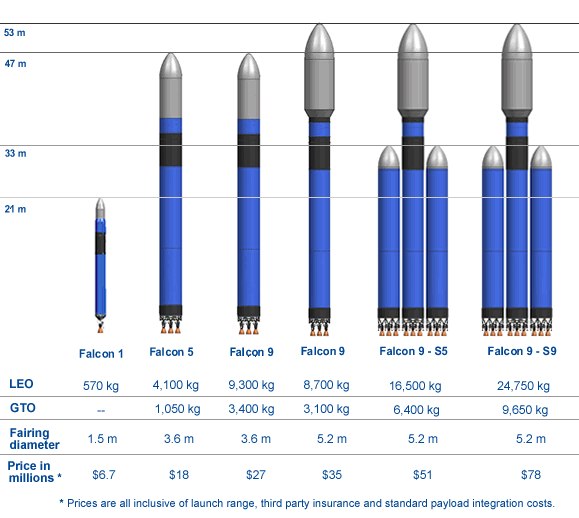
Whereas Falcon 1 is the world’s lowest cost per flight to orbit of a production rocket, Falcon 5 and Falcon 9 will offer the lowest cost per pound/kilogram to orbit, despite providing breakthrough improvements in reliability. A half bay flight of Falcon 5 is available at $9 million to accommodate customers with payloads in between Falcon 1 and 5.
The Falcon 1 user's guide is currently undergoing revision and will be availble online shortly. A user's guide will also be available for Falcon 5 and Falcon 9 later this year. We would be glad to run a customized trajectory analysis for your spacecraft at no charge, simply email us at FalconGuide@spacex.com.
Falcon 5 and Falcon 9 make use of the exact same first and second stage tank structure, with the only difference being the number of engines on the first stage. In the case of a Falcon 5 launch, four of the nine engines are removed prior to flight and the first stage is only partially filled with propellant. This minimizes development, manufacturing and ground support equipment costs, and brings to market two launch vehicle classes at once.
Fairing Volume
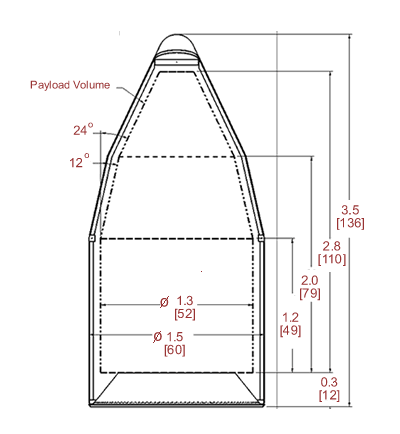
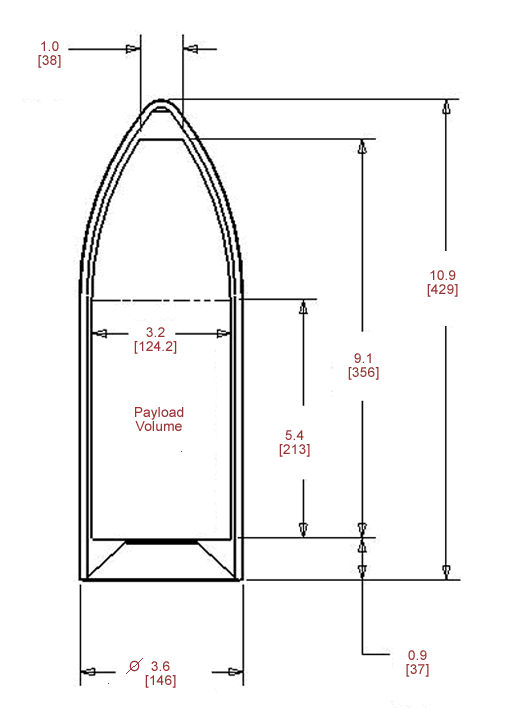
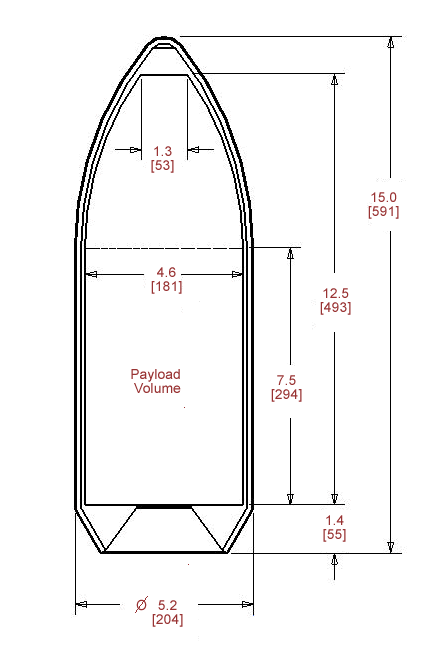
Below are the standard fairing dimensions for Falcon 1, Falcon 5 and Falcon 9. Dimensions are in meters and in inches inside the parentheses. Drawings are not to scale in relation to one another.
Custom fairings in larger lengths and diameters are available at incremental cost.
FALCON 1 - 1.5 m fairing
|
FALCON 5 and FALCON 9 - 3.6 m fairing
|
FALCON 5 and FALCON 9 - 5.2 m fairing
|
Why do we believe Falcon is a high reliability design?
The vast majority of launch vehicle failures in the past two decades can be attributed to three causes: engine, stage separation and, to a much lesser degree, avionics failures. An analysis of launch failure history between 1980 and 1999 by Aerospace Corporation showed that 91% of known failures can be attributed to those subsystems.
Engine Reliability
It was with this in mind that we designed Falcon 1 to have the minimum number of engines. As a result, there is only one engine per stage and only one stage separation event – the minimum pragmatically possible number.
In the case of Falcon 5, there are five first stage engines and Falcon 9 has nine Merlin engines clustered together. These vehicles will be capable of sustaining an engine failure at any point in flight and still successfully completing its mission. This actually results in an even higher level of reliability than a single engine stage. The SpaceX five and nine engine architectures are improved versions of those employed by the Saturn V and Saturn I rockets of the Apollo Program, which had flawless flight records despite losing engines on a number of missions.
Another notable point is the SpaceX hold-before-release system – a capability required by commercial airplanes, but rarely seen on launch vehicles. After first stage engine start, the Falcon is held down and not released for flight until all propulsion and vehicle systems are confirmed to be operating normally. An automatic safe shut-down and unloading of propellant occurs if any off nominal conditions are detected.
Stage Separation Reliability
Here Falcon takes advantage of simplicity by having two stages and therefore only one stage separation event – the minimum practical number. Moreover, the stage separation bolts are all dual initiated, fully space qualified and have a zero failure track record in prior launch vehicles.
Avionics Reliability
Falcon 5 and Falcon 9 will have triple redundant flight computers and inertial navigation, with a GPS overlay for additional orbit insertion accuracy. We have gone the extra mile in building a first class avionics system to provide small and medium class satellites with the same avionics quality enjoyed by multi-billion dollar large satellites.
|